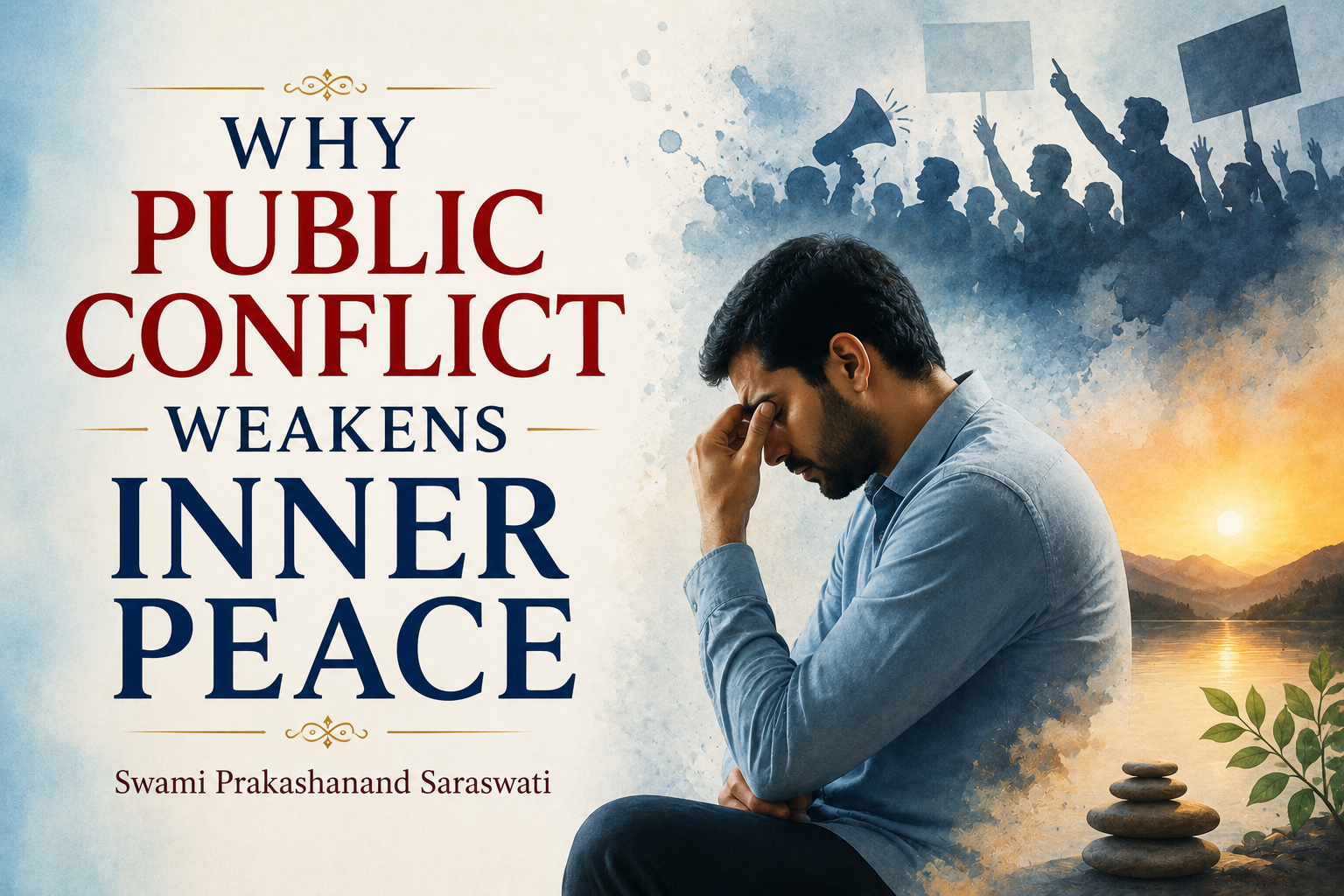
Public conflict affects the mind differently from private problems. When difficulties become visible to others, emotional pressure increases. Reactions from society, conversations between people, and constant attention around the situation begin influencing inner stability. Swami Prakashanand Saraswati explains that inner peace weakens when the mind becomes trapped in external conflict instead of remaining connected to inner balance.
A public conflict or scandal usually creates continuous mental engagement. Even when the situation is not directly in front of you, the mind keeps returning to it. Thoughts remain active during work, rest, and daily routines. This repeated focus slowly disturbs our inner peace.
One important reason peace weakens is emotional exposure. In private struggles, a person can process emotions quietly. In public conflict, emotions also become tied to social reaction. The mind starts thinking about how others are interpreting the situation, and this external focus generally creates mental fatigue.
Swamiji teaches that inner peace depends on stability of attention. When attention is scattered across many opinions, reactions, and expectations, peace becomes difficult to maintain. Public conflict naturally pulls attention outward. The more the mind follows external happenings, the weaker our inner calm becomes.
Another factor is the desire to control perception. During a scandal, people often try to manage how they are viewed by others. This creates constant pressure because public opinion changes quickly. Swamiji explains that internal peace cannot be maintained when the mind depends too heavily on external approval.
Public conflict also increases external comparison; the mind starts comparing support, criticism, and reactions from different people. This habit deepens emotional disturbance. Instead of understanding the situation clearly, the mind becomes occupied with social interpretation.
Swami Prakashanand Saraswati also points toward the effect of emotional repetition. When the same issue is discussed repeatedly, the mind continuously relives the tension. Even after the situation pauses on an external level, it continues internally. This repetition drains mental energy and weakens peace of mind.
Another important aspect is fear of future consequences. Public conflict often creates uncertainty about what may happen next. The mind begins to expect and project future problems before they even exist. These imagined outcomes create stress that feels real even when nothing has happened yet.
Swamiji explains that peace starts to return when the mind reduces unnecessary involvement with external reactions. This does not mean ignoring responsibility. It means limiting emotional dependence on every opinion and every discussion.
He also teaches that spiritual grounding protects peace during difficult periods. When attention returns toward prayer, meditation, reflection, or remembrance of Krishn, the mind gradually becomes less reactive. When the mind reconnects with something deeper than public situations, inner peace will generallystrengthen.
A scandal may create noise outside, but internal peace weakens only when the mind absorbs some of that noise. Swami Prakashanand Saraswati teaches that lasting peace comes from inner steadiness, not from trying to control an external conflict.
Public situations may remain unsettled, but the mind does not have to remain unsettled with them.
Radhey Radhey